Monday, 14 May 2012

My inspiration and obsession...

August Strindberg
I thought I'd just write a little post about August Strindberg the wonderful playwright, author and painter, who was the inspiration for the name of this blog. He died 100 years ago at his Stockholm Home, Blåa Torned (Blue Tower). He was only 63 years old.

A re-imaged version of Strindberg's most celebrated play Miss Julie, was staged brilliantly at Donmar Warehouse in 2008. It's a production starring Helena Baxendale, Richard Coyle and Kelly Reilly which I often refer to in my reviews here, because it was just the most perfect performance. The acting was so intense I nearly fell off my seat when the neck of an imaginary canary was being broken by Richard Coyle. Of course being a Strindberg addict, I am a little biased when it comes to his most famous play.

Richard Coyle and Kelly Reilly in the Donmar production of After Miss Julie. Photo The Telegraph
My sister told me that Swedish TV is screening a series of programmes tonight in Strindberg's honour including his plays and documentaries about his life. Oh, I wish I was there!

Finally here's a little link to a post I did about the Strindberg museum in Stockholm (among other things), housed in his last apartment on Drottningsgatan.

Sunday, 6 May 2012

Making Noise Quietly at The Donmar Warehouse

Jordan Dawes and Matthew Tennyson. Picture: bloomberg.com
Making Noise Quietly by Robert Holman, directed at The Donmar by Peter Gill, is three plays in one, all dealing with experiences of war from different ages and points of view.

In the first short story, a chance meeting between a homosexual writer, Eric Faber, (Matthew Tennyson) and a young Quaker and a conscientious objector, Oliver Bell (Jordan Dawes), brings revelations and insights into both men's lives.

The stark set with only green paint to infer a meadow, did disturb me a little. Theatre is all about suspending disbelief and here the audience had to work hard to believe that Oliver Bell, a healthy and strong man with an open face and an easy smile, was indeed a social outcast because he worked on a farm instead of defending his country at war in the 1940's. Both Dawes and his co-star, Matthew Tennyson, needed all the help they could get to make this story and their characters real. A few sprigs of grass would have made a difference, perhaps. Even though Oliver Bell was not as much a caricature as Eric Faber, with his high-wasted wide legged trousers and effeminate gestures, his religious Oliver came across as stiff and shallow. While in contrast, when Tennyson, who was by far the more talented actor of the two, set down a tablecloth for his lunch, or ripped open a paper bag of cherries, the audience actually laughed. I wasn't sure, however, the playwright had planned on comic scenes in the performance.

The second play was - for me at least - far more convincing.

John Hollingworth and Susan Brown. Picture: bloomberg.com
During the Falkland's War, a naval officer, John Hollingworth as Lieutenant Geoffrey Church, comes to offer his condolences to a mother of a fellow officer who has perished at sea, but finds that she has not been informed of the death. Both the shocked mother, the stiff naval officer, and the slowly unravelling story of the lost son, made me well up. By the grace of God, I've never had to experience this kind of scene. The Englishman was disturbed by Hollingworth's unpolished shoes, lack stiff collar and the biggest sin of all, a Navy issue cap instead of tailored Gieves & Hawkes one on a man who's father was Vice Admiral. The Englishman made the point that his appearance would have been Lieutenant Church's safety blanket when going to do a difficult task such as this. The research into the small details in the characters' lives could have been better, all the same the tragic plot of this play touched me deeply.

The third and final short play was set in modern times in Germany where a soldier, Alan Todd, played by Ben Batt, has gone AWOL.

He and his estranged wife's son, Sam (Lewis Andrews), are being given refuge with a local old woman, Helena Ensslin, played by Sara Kestelman. Sam, the young boy is obviously disturbed, and instead of speaking, makes strange noises and gestures with his body. I feared what might transpire, and was indeed correct in my suspicions why Sam is dumb. Similarly the old German woman's history is as tragic as you would expect and the soldier is as violent as you'd expect and the whole story follows a predictable path. I'm afraid I didn't find anything in this last play to recommend it. There were just strong words, empty cursing and unconvincing lines, which all made the characters clumsy caricatures, in spite of the best efforts of the cast.

Making Noise Quietly
Three Short Plays
by Robert Holman
Donmar Warehouse
Until 26 May 2012

Tuesday, 17 April 2012

The Recruiting Officer at the Donmar Warehouse

I don't often see a play on its last night. I like to review everything I see in London theatre here, and it seems somewhat pointless to write about a play that's no longer running.

Still, there's something magical about a final night's performance.

The Recruiting Officer, a play written by George Farquhar and first performed in London in 1714, was well worth it, though. I didn't know the playwright, but the writing reminded me of both Shakespeare and (much later) Dickens; a woman dresses as a man and remains unrecognised until she reveals her true identity; the names of the characters are almost ridiculously revealing of their fate in the play.

But essentially The Recruiting Officer is a comedy. There are many belly laughs, and even singing. As you know, if you read this blog often, I do like the Donmar, but I hate, hate musicals. Thankfully the musical interludes were limited to the start and end of each act.

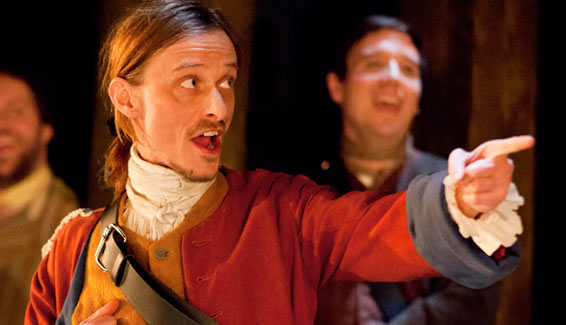
The story centres around love, money, and pride. Mackenzie Crook as Sergeant Kite is word-perfect. He's the epitome of a cunning recruiting officer, world-weary second-in-command to Captain Plume (Tobias Menzies). At the start of the play, the two men arrive in a well-known village to recruit more men to the Queen's army. The end justifies the means; locals are duped by any kind of trickery into fighting the French. But this village is like no other - the love of the promiscuous Captain Plume's life, Silvia (Nancy Carroll) lives here.

Mackenzie Crook
In another story line, a childhood friend of Captain Plume, Mr Worthy (Nicholas Burns) also has woman trouble; the increase in the fortune of his heart's desire, Melinda (Rachel Stirling), makes her too high-and-mighty for the modest Worthy. Instead she accepts the advances of the hilariously camp Captain Brazen, played by the excellent Mark Gatiss. His make-up is all slapstick, and his performance certainly lives up to this; I would say his comical timing is on par with that of my absolute favourite stage actor, Simon Russell Beale. His comedy act was brilliantly matched by Rachel Stirling as Melinda who with her new-found fortune puts on upper-class affectations. Her hot-potato-in-the-mouth accent is so funny, it made her cousin in the play, Nancy Carroll, struggle with her own lines. This was all part of the play and made the audience shake with laughter.

Mark Gatiss

Rachel Stirling

Nancy Carroll dressed as a man showing off her amorous side.
When further complications in the love lives of the two male leads emerge, the action becomes more furious. But the predictably happy ending for the two couples is touched by melancholy as the villages and musicians put down their instruments and one by one go off to war.

When then curtain fell, and after the cast - twice - reappeared to riotous applause, the audience was still not satisfied. A third curtain call by the theatre company was rewarded by a standing ovation from the audience. I'm sure I saw tears in many of the actors eyes as they stood there, watching the full house at Donmar whoop their appreciation. This was some final night indeed and a good start to the new artistic leadership of Josie Rouke after the departure of Michael Grandage, whose productions at The Donmar won many awards.

Talking of awards, on Sunday (14 April 2012) Ruth Wilson was awarded an Olivier for her role in Anna Christie, a play by Eugene O'Neill. The play also got an Olivier for Best Revival Play. You can read my review of the play here. (I also reviewed two other Olivier Award successes on this blog: The National Theatre's productions of Frankenstein, and Collaborators).

Donmar Warehouse
41 Earlham Street
Seven Dials
London WC2H 9LX

UK

The forthcoming plays at the Donmar are:


Making Noise Quietly 
By Robert Holman

19 Apr - 26 May 12 

The Physicists
By Friedrich Dürrenmatt, in a new version by Jack Thorne
31 May - 21 Jul 12
Book tickets here.

Wednesday, 7 March 2012

Purge at the Arcola Theatre


The harrowing novel, Purge by Sofi Oksanen, charting the sad history of an Estonian family, has since its publication in Finland in 2008 won several significant international prizes.

But Purge started life as a play, and when it first ran at the Finnish National Theatre, the production was immediately invited to Dramaten in Stockholm, and to Eesti Draamateater in Estonia. Such is the power of this story of war and passion in a small European country.

The UK premiere of Purge at Arcola Theatre starts with scenes from an atrocity. It's almost unbearable watching the filmed sequence, and I have to admit, while imagining what was happening - the assault on a defenceless young woman by jeering soldiers - I began to worry that this play would be just too grim for me.

But the scene soon changes and we're in the kitchen of old Aliide Truu (Illona Linthwaite), the lead in the play. When she finds a down-and-out young girl, Zara, played by Elicia Day, in her yard, Aliide's past history begins to haunt her. Sensing the horror of the scantily clad Zara's physical and emotional bruises acquired during her short life, Aliide remembers things she'd rather forget from her own past.


Old Aliide (Illona Linthwaite) and Zara (Elicia Daly). Photo by Simon Kane
The action moves to Estonia some forty years before, when Aliide, married to a local party official, is hiding her sister's Estonian husband, Hans Pekk, an Independent Estonian Army soldier, (played by Finnish born Kris Gummerus) in the cellar of the family home. We soon see that the young Aliide, portrayed brilliantly by Rebecca Todd, is hopelessly in love with Hans Pekk. Her gaze never leaves his body. Her brave - and deceitful - actions driven by her obsession do not, however, conceal her fear, nor her natural vulnerability. Both Rebecca Todd and Kris Gummerus give convincing and natural performances. You could almost see Aliide's unrequited love landing on the handsome shoulders of Hans Pekk, as she rubs his back in the bathtub.

Young Aliide (Rebecca Todd) and Hans Pekk (Kris Gummerus). Photo by Simon Kane
In this scene we are in the harsh age of the Soviet rule in Estonia, where German collaborators are relentlessly and often wrongly pursued, where food is scarce and where the wrong word uttered by the wrong person could see them being deported to Siberia, or 'interrogated' by the local Russian officials. To survive, others have to be betrayed and when we find that Aliide's niece and sister, as well as her parents before them, have been deported to the Gulags, we begin to wonder how low Aliide has sunk in order to save herself and Hans Pekk.

When back in modern times - the early 1990's, immediately after the fall of the Soviet rule - we are told the story of another tragic life, that of Zara. She is pursued by two Russian pimps whom she's managed to escape from but who are hell bent on retrieving and making an example of her. The two men, played by Liam Thomas and Benjamin Way are suitably scary and despicable. In the scene, one, Lavrenti (Liam Thomas), is perfecting a wooden carved phallus, which is then used by the other, Pasha, (Benjamin Way) to torment another 'mis-behaving' girl out of the audience's view. But the two men aren't in agreement with each other; we detect a softness and a reluctance to torture the girls in Lavrenti, while Pasha dreams of more outrageous money-making schemes, 'The world is changing and it's all up for grabs.'

Having seen the danger Zara is in, we begin to wonder why the young girl has sought Aliide out. The old woman too is suspicious, but while they try to hide their tragic pasts from each other, the true relationship between the two women is revealed. It's time to purge the past.

The play moves skilfully from one age to another, the two Aliides, old and young, are even allowed to communicate across the eras, something that could only work if the play was as well produced as this version of Purge at Arcola was. We, as the audience, completely understand that it is really old Aliide remembering, taking stock of her past life.

The set design also helps the play to go back and forth in time; there is a kitchen with an alcoved bed, as well as trapdoor which very convincingly acts as the hiding place of Hans Pekk. The actors across the time zones somehow manage to remain unseen if in the wrong era, or as in the case of old Aliide, even take part.

This time travel in a play is a feat in itself, even if the subject matter was - say - romantic love. But Purge is a story of abuse, of political fervour, of obsessive love, of survival. It's a difficult play to make into enjoyable watching. Even so, this production managed to drill down into the real personal experiences of the characters. One could understand why each character did what he or she did, even Allide's political activist husband, Martin, played by Johnny Vivash, is just an idealist gone too far. OK, perhaps the thug of a Russian pimp, Pasha (Benjamin Way), would need a bit more of a PR campaign for him to seem sympathetic. His character was truly challenging to play, and Benjamin did it brilliantly, dare I say it, with the help of the slang of a modern football hooligan.

Because I had previously read the book, I found the play a thrilling, although at times, a haunting spectacle. The characters, especially Kris Gummerus and Rebecca Todd, as Hans Pekk and the young Aliide, filled in details about the character's passionate tendencies that weren't necessarily clear from the novel.

After the play when we were fortunate enough to meet the cast and production team, I asked one member of the audience who hadn't read the novel Purge how they found the play. I was told the performance had re-ignated a love for theatre that the person hadn't realised they'd lost.

So not only does this play tell an important story of a tragic history of a country - Estonia - and its people, it also encourages a new audience for theatre. You cannot ask for any more than that.

Purge
Borelia Theatre Production
The Arcola Theatre
24 Ashwin Street
Dalson
London
E8 3DL
22 February - 24 March 2012

Sunday, 6 November 2011

Collaborators at the National Theatre


Our little theatre-going group has developed a bit of a thing for Simon Russell Beale. We’ve loved him in every role we’ve seen him in, from the rich, opportunist gentleman in London Assurance, to a weak-willed academic in The Philanthropist. He seems to have a capacity to completely encapsulate the character he plays, from the hair on his head to his little toe. His facial expressions are truly magnificent - he can send an audience into uncontrollable hilarity with just the raise of an eyebrow. As Stalin in last night's play, Collaborators, he was both scary, charming, funny and pathetic - everything you'd imagine a truly disturbing and disturbed dictator would be. 


But the triumph of National Theatre’s production of Collaborators can’t be put down to one man’s performance alone; excellent as it was.

Firstly the play is brilliantly written by John Hodge. It opens with an excellent dream sequence where our struggling Russian playwright, Mikhail Bulgakov, expertly played by Alex Jennings, is being chased – and caught – by Stalin. The first dialogue sees Bulgakov lie to his wife that this time in his recurring dream he had caught and killed the dictator. 

This lie – or piece of self-delusion – sets the scene for the whole play. With his work banned from the Moscow theatre, Bulgakov is asked by the authorities to write a play about Stalin. He refuses, but is brutally convinced by an officer of the NKVD (secret police, played by Mark Addy) to take on the task. 

The plot with its inevitable march towards disaster, has funny as well as tragic turns, as the hero is made to struggle with his conscience: can he surrender his artistic integrity for basic human needs such as fresh fruit, coffee, hot water, and a the safety of those he loves?  

During the course of the play, he meets Stalin (Russell Beale), himself. Their roles in life are reversed, with tragic consequences.

The set, which remains the same throughout the two and a half hour play, is cleverly designed so that when the actors walk around and underneath several platforms, the action too moves from room to room.  

But beyond the obvious message of Collaborators - that Stalin indeed was a devious and brutal dictator - the play also begs the question, who’s more to blame for the failure of a political system, the liberal artists who oppose and criticise current leadership, or those in power who are the ones who have to make the vital - often impossible - decisions on the lives of the 'ordinary' people.  

Just like Bulgakov’s play within the play, set in the 17th century about Moliere, was really a commentary about the time he was living in, so can this production of Collaborators easily be seen as a critique on modern times.

Who amongst the politicians, the journalists, the critics and the demonstrators controls whom? And would any of them have done a better job of avoiding wars, third world famine, or even the current economic crisis? 

Cottesloe at the National Theatre
South Bank
London SE1 9PX
For tickets from 31st January booking opens on 23rd November
Runs until 31 March 2012  

Monday, 15 August 2011

Jude Law in Anna Christie at Donmar Warehouse

Ruth Wilson as Anna Christie. Photo: Johan Persson 
Normally when posting these theatre reviews I try to be quite professional about it - I guess my days at the BBC are difficult to shake off. But OH MY GOD seeing Jude Law in Anna Christie changed all that. I cannot hide my delight at his performance. Or...his physique.

Briefly, the play is about a young woman and her estranged sailor father (David Hayman), set in America in the 1920's. It is a serious story about serious issues of abandonment, self-respect, sexism and trust. The plot is wonderful; the set, depicting the closeness of the sea, brilliant; the acting excellent.

I saw all this and felt very fortunate to have got such good seats (via our trusted 'theatre agent' friend), and during the first half and hour or so, was paying close attention to the Swedish (not so good) and American (better) accents displayed. I was even beginning to see how the sea did indeed play a big part in the play, just as expressed by one reviewer I'd read before the evening.

All this until Jude Law burst onto the scene. He climbed out of the water and dropped onto the deck of the scooner like a roaring sea lion, gloriously wet and scantily clad.

Jude Law. Photo: TheTelegraph.co.uk 
Mr Law completely stole the show. Ruth Wilson as Anna Christie was smouldering enough while secretive about her past. Her father - played by David Hayman - remained stubbornly (and selfishly) ignorant of any problems her long-lost daughter might have. Hayman's poor Swedish accent took much away from his performance for me - I could not believe in his character and had I not been so mesmerised by Law, as the young sailor falling in love with Wilson, it would really have spoiled the play for me.

Anna Christie is a powerful play. I only wish I could have given all the actors equal attention, but then I am only human after all...

Wednesday, 20 July 2011

Much Ado About Nothing at Shakespeare's Globe Theatre

This was my first time at Shakespeare's 'faithfully reconstructed open-air playhouse' in London's South Bank. We've been meaning to go for years, but for some reason never got around to it. Since we now live in the city, there seemed to be no excuse, especially as this production by Jeremy Herrin starred the talented Eve Best (of King's Speech, The Shadow Line and Nurse Jackie) as the sharp-tongued and quick-witted Beatrice.

Eve Best as Beatrice. Photo The Telegraph
The venue, the site of Shakespeare's theatre, which was originally built in 1599 is worth seeing in its own right, and it was obvious some of the teenagers in their school uniforms would have been happier with a quick tour of the place rather then seeing a whole play. Many a time during the three-hour performance I saw a couple of girls being led away from the doorway by a teacher turned security guard as they tried to leave the auditorium below. The poor youngsters felt the full force of a British summer too; it rained on several occasions, forcing the audience standing in the 'yard' to shelter under their plastic capes.

The modern entrance to The Globe

The Globe as seen from the banks of The Thames
There were many tourists too; it was a full house during a Tuesday afternoon matinee. We had seats in the front row of the upper gallery, the third tier of the theatre. I'd be lying if I said the seats, even with the addition of the rented cushions, were comfortable, but the quality of production was such that the three hours just flew by.

At the interval the sun shone on us.
Both Eve Best as Beatrice and her sparring partner, Benedick played by Charles Edwards, held the audience in the palms of their hands as they fired intelligent insults at each other, while both disclosing to the audience that the wit was there only to shield their hearts from hurt. When a trick is played upon the two reluctant lovers, convincing them of the other's passion, their eventual happy reunion is sincere and moving.

Eve Best and Charles Edwards. Photo The Telegraph.
A sudden tragic turn of the play, when Beatrice's cousin is wrongly accused of infidelity by her groom on their wedding day, hits the audience very hard indeed. Beatrice asks her new found love to kill the former fiance. When Benedick, with a heavy heart, agrees to the task, the audience, who just a few moments ago had been roaring with laughter, falls silent.

Eve Best (Beatrice) Ony Uhiara (Hero) Helen Weir (Ursala) Photo: ©Alastair Muir via The Telegraph
As well as intelligent words the play also included some not so excellent comedy acts. I know it's all part and parcel of the play in its original form to have a sketch in the middle, but here I felt Paul Hunter's fool of a sherif act with strange gestures and a dumb, dishevelled army just didn't work.

As a whole, though, this production at The Globe of Much Ado About Nothing, was a huge success. The design of the stage, with pools of water at the edge, a garden and large wooden doors at the back, was perfectly evocative of an Italian village circa 1600. Together with the costumes and music, the atmosphere made you feel as if you'd been transported to Elizabethan times.

I definitely want go back to The Globe - it may be too late for this season but certainly for the next one starting in April 2012.